

An AI agent compiles a customer table into a spreadsheet and stages it for sharing. It had every permission the job required, and no rule fired. Whether that was a problem depends on three things: what the data was, what the agent was trying to do, and what it actually did.
Data. Intent. Behavior. Take away any one and the question has no answer. Data without intent flags every agent that touches a customer record. Intent without behavior takes the agent at its word. Behavior without data is a log of tool calls with no idea what was inside them.
Rules give you a thin slice of the first. Supervisor models could give you all three, at a cost close to that of the agent they watch. Agent DLP delivers data, intent and behavior on every action, for less than 10% of the agent's token cost.
Three questions every agent session raises
Every agent session comes down to three questions, and each needs its own kind of evidence.
- Data: what is the agent accessing? Names, identifiers, secrets, financial figures, MNPI or health records. A file write means nothing until you know what is in the file.
- Intent: what is the agent trying to do? The task the user gave it, and the business purpose behind it. The same query can serve a billing fix or an export of the customer base.
- Behavior: what did the agent actually do? Every prompt, tool call and result, in order: which systems it reached into, what it wrote, where it sent it.
Risk lives where the three meet. Sensitive data inside the task is authorized work. An odd tool call on public data is noise. Sensitive data, moved by behavior the intent does not explain, is exposure. With only one or two of the three, you either miss it or bury your team in alerts about agents doing their jobs.
Rules are blind. Supervisor models are unaffordable.
There are two ways to watch an AI agent today, and neither gives a CISO all three.
Rules are cheap but blind. A rule checks one action at a time against a pattern someone already wrote. It catches the data patterns it was told about and knows nothing about intent or about what the agent did before. Agents do something new every session, and an agent can stage a customer table for sharing, one ordinary action at a time, without tripping a single rule.
Supervisor models are smart but expensive. The only thing that understands what an agent powered by a smart model is doing is another equally smart model. Have one read every action and you have roughly doubled the cost of running the agent. OpenAI's own estimate, after engineering most of the work down to cheap probes and sampled review, is still north of 20% of the inference being watched.
OpenAI has rebuilt its monitoring into layers of probes, reviewer models and investigative agents, and accepts the compute bill as the price of frontier research. A security budget is not a frontier lab's.
| Approach | Data | Intent | Behavior | Cost, as a share of the agent's tokens |
|---|---|---|---|---|
| Rules and patterns | Only the patterns someone already wrote | No | No | Cheap |
| Supervisor model | On the actions it reads | Yes | Sampled, unless you pay for every action | About 100% on every action; 20% or more sampled |
| Agent DLP | Every action | Every session | Every action | Under 10% |
Agent DLP covers data, intent and behavior for action, at a price a security budget can carry.
How Agent DLP gets all three on every action
Agent DLP splits the work between two speeds, and no large model sits in the request path.
The inline check supplies data and behavior. It sits in the path of every prompt, tool call and result, and answers in milliseconds. It recognizes the sensitive data in the traffic, tracks what the agent does with it, and returns a verdict: allow, alert, mask or block.
The session review supplies intent. It never sees a request in flight. It works out what each session is trying to do, such as "This agent is assembling a per-employee dataset and preparing it for export."
The two work together. What the session review learns is enforced on that session's next action, at inline speed. Every session also applies the organization's policy, written in natural language.
The verdict resists tampering. A supervisor model judges an action by reading the same prompts and tool results the agent reads, so an instruction planted in that text can mislead the judge along with the agent. Agent DLP's verdict comes from an inline check that matches that text as data and never takes it as instructions.

Two speeds: the inline check answers on every action, and the session review runs when there is something to learn.
All of this happens inside a single session, without anyone writing a policy.
The session review's attention follows how interesting a session is rather than how large the fleet is. A routine session gets a glance. An unusual one is revisited within minutes. That is how Agent DLP stays under 10% of the token cost of the agents it governs.
All three, in two real sessions
The findings that matter most are the ones nobody wrote a policy for. Two sessions show why each one took all three signals.
A financial customer. Agent DLP flagged a session that had compiled records for 52 named employees, with their usage and cost, into a spreadsheet and a report staged in a shared output folder. No bulk-personal-data policy existed. Agent DLP inferred that the agent was assembling a member-level dataset for export, and confirmed it within a few actions. The person running the session hadn't noticed.
A healthcare customer. A developer asked Claude Code to resolve duplicate medical record numbers in a clinical warehouse and send a masked list to a claims clearinghouse. Authorized work, and the agent did it well. Halfway through, the Key Vault secret for the clearinghouse SFTP account turned out to be expired. The developer got a replacement password over the phone and pasted it into the chat. The agent used it, uploaded the file and moved on.
The ticket was closed, and nothing in a permission model objected. Agent DLP had read the session as healthcare data leaving the warehouse, so it was watching that upload closely. The password showed up in clear.
| Session | Data | Intent | Behavior | Finding |
|---|---|---|---|---|
| Financial customer | Records for 52 named employees, with usage and cost | Assembling a member-level dataset for export | Wrote a spreadsheet and a report to a shared output folder | Bulk personal data staged for sharing |
| Healthcare customer | Medical record numbers and an SFTP password in clear | Fixing duplicate records and sending a masked list to a clearinghouse | Used a password pasted into chat to upload the file | Secret in clear, bypassing secret rotation |
No policy was configured for either finding. Remove any one column and the finding disappears. Without data, the first session is a file write to a shared folder. Without intent, it is one more agent reading usage records. Without behavior, nobody knows the file was staged for sharing.
That is the shape of most findings: an agent doing its job, a human taking a shortcut, and data or a credential going somewhere it should not. The two classic cases look the same. Agent overreach shows up as behavior that drifts away from what the session was asked to do. User-directed misuse, where a person spreads a forbidden objective across requests that each look fine, shows up once those requests are read together as a single intent.
Day one: all three, before you write a policy
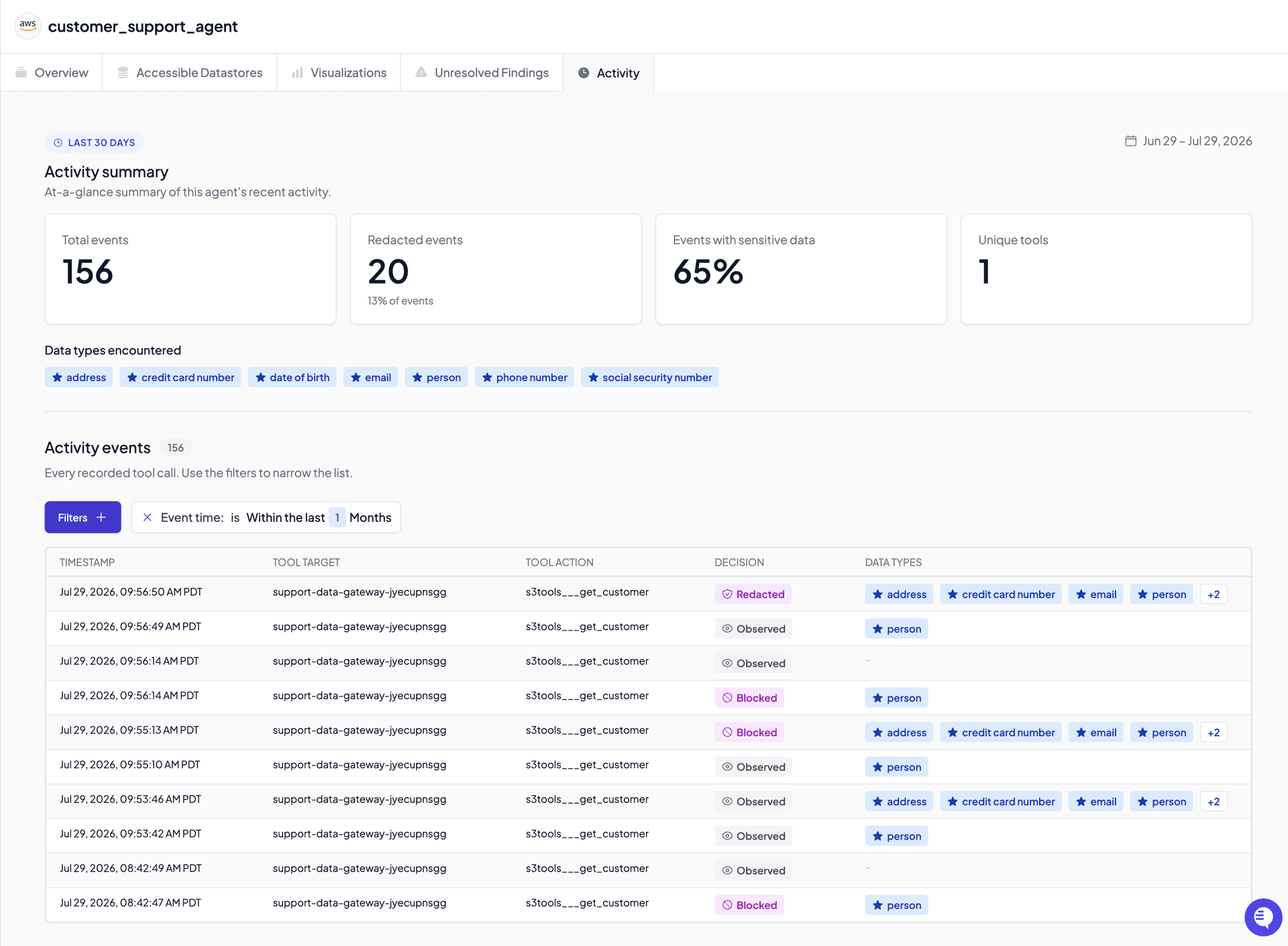
The first thing a security team sees is an answer to a question most of them cannot currently answer: what are our agents actually being used for? Observe-only mode builds that picture from the first day, before any policy exists, along the same three lines.
- Data. Every session carries tags for the data it touched, such as credentials or healthcare data, and the dashboard regroups the same activity by data domain.
- Intent. Thirty days of agent activity, grouped by what Agent DLP inferred each agent was doing: building payment features, resolving production incidents, developing software features. Nobody labeled these.
- Behavior. Which systems agents are reaching into, by MCP provider, with the tools and call counts under each. This is the inventory most teams do not have.
Deployment can be cloud to cloud, with nothing on endpoints. Claude Enterprise sends every governed turn to Agent DLP through Anthropic's inference hooks, covering Claude Code, Claude Cowork, Claude on the web and apps built on Claude. NVIDIA OpenShell and AWS Bedrock AgentCore call Agent DLP from inside the runtime and enforce its verdict at their own boundary. It also connects as a hook in tools such as Claude Code and Codex, and at gateways such as LiteLLM and Bifrost. Teams start in observe-only mode to see how their people use agents and where the risk is real, then turn on enforcement.
Data, intent and behavior, available today
Rules give you patterns. Supervisor models give you a bill. Agent DLP gives you data, intent and behavior on every action, for under 10% of what the agent costs to run.
Agent DLP is generally available today as a standalone product and as part of the Bedrock Data ArgusAI platform.
For a closer look at how it works, request a demo or see Agent DLP at AWS re:Invent 2026 in Las Vegas, November 30 to December 4.