The short version

Full coverage, no cost tradeoffs.
Brute-force scanning forces legacy tools to limit coverage to control cost. Bedrock Data gives you 100% of your risk surface without that tradeoff.

Petabytes in hours.
Scans that take days or weeks at scale finish in hours, which is why Bedrock Data costs a fraction to run.

Real exposure, not alerts.
Bedrock Data combines precise classification with live identity and access context, so you fix what is truly exposed.

Built for AI.
Bedrock Data governs the AI risk surface, the agents, copilots, and connectors that can access your data, not just the data that flows into models.

Your data never moves.
Analyzed in place, 100% private.
How Bedrock Data compares
BigID legacy DSPM | Bedrock Data | |
|---|---|---|
Coverage vs cost | Brute-force scanning is costly, so coverage is limited to control spend, leaving partial visibility | 100% coverage of your risk surface, with no cost tradeoff |
Speed at scale | Scans can take days to weeks at petabyte scale | 2 hours per PB scanned |
Cost to run | Enterprise pricing that climbs with data volume and connectors | A fraction of the cost; 25x lower infrastructure cost |
Classification | Pattern-based classification needs tuning cycles and produces false positives | AI classification by business context, not just patterns, with fewer false positives |
Real exposure | Maps where data lives; governing who can access it is a separate problem | What is sensitive, who can access it, and the risk it carries, in one view |
Data handling | Deployment models vary; some require moving or copying data or standing up scanner infrastructure | Your data never moves; analyzed in place, 100% private |
AI governance | AI governance focused on the data flowing into models and copilots | Governs the full AI risk surface: agents, the connectors that broker access, and the retrieval path |
Ecosystem | Context can stay siloed, with findings exported to other tools | The same context fed into every tool, so your whole stack gets smarter |
Coverage vs cost
BigID legacy DSPM
Brute-force scanning is costly, so coverage is limited to control spend, leaving partial visibility
Bedrock Data
100% coverage of your risk surface, with no cost tradeoff
Speed at scale
BigID legacy DSPM
Scans can take days to weeks at petabyte scale
Bedrock Data
2 hours per PB scanned
Cost to run
BigID legacy DSPM
Enterprise pricing that climbs with data volume and connectors
Bedrock Data
A fraction of the cost; 25x lower infrastructure cost
Classification
BigID legacy DSPM
Pattern-based classification needs tuning cycles and produces false positives
Bedrock Data
AI classification by business context, not just patterns, with fewer false positives
Real exposure
BigID legacy DSPM
Maps where data lives; governing who can access it is a separate problem
Bedrock Data
What is sensitive, who can access it, and the risk it carries, in one view
Data handling
BigID legacy DSPM
Deployment models vary; some require moving or copying data or standing up scanner infrastructure
Bedrock Data
Your data never moves; analyzed in place, 100% private
AI governance
BigID legacy DSPM
AI governance focused on the data flowing into models and copilots
Bedrock Data
Governs the full AI risk surface: agents, the connectors that broker access, and the retrieval path
Ecosystem
BigID legacy DSPM
Context can stay siloed, with findings exported to other tools
Bedrock Data
The same context fed into every tool, so your whole stack gets smarter
Disclaimer: Comparison based on publicly available information, customer reviews, and general DSPM architecture, current as of June 2026. Product capabilities change; verify current details with each vendor. BigID is a trademark of its respective owner.
Where legacy DSPM breaks.
You pay more to cover less
Brute-force scanning is so expensive, and every datastore has to be configured and tuned by hand. So tools limit what they cover, and you pay enterprise prices for partial visibility into your own risk.
Scanning cannot keep up with scale
At petabyte scale, scans drag on for weeks or months. You wait to see your risk, and you pay more for the privilege.
False positives bury the signal
Their classification floods your team with false positives, so real risk hides in the noise and every alert costs time to rule out.
Data and Identity never meet
Knowing where data lives is not the same as knowing who can access it and what that exposure is worth. Legacy tools stop short of the answer.
Built differently.
Proven where others break.

Full visibility. No cost tradeoffs.
Bedrock Data's serverless scale-out architecture scans multi-petabyte environments at high speed, without the brute-force cost that forces other tools to limit coverage. See your full data risk without blowing up your budget.

Real exposure
A noisy, false-positive-prone inventory is not risk reduction. It is busy work. Bedrock Data understands material risk by combining precise classification with live identity and access context, so you fix what is truly exposed.
Your data stays put.
Adding a security tool should not create a new attack surface. Bedrock Data analyzes your data where it lives. It is never copied, exposed, or read outside your environment, maintaining strict data residency and control.

Ubiquitous data context.
Other tools operate in a silo, leaving every downstream tool flying blind. Bedrock Data feeds the same data and identity context into your whole stack, so every tool operates from the same ground truth.
Identity and access, in context, including your AI
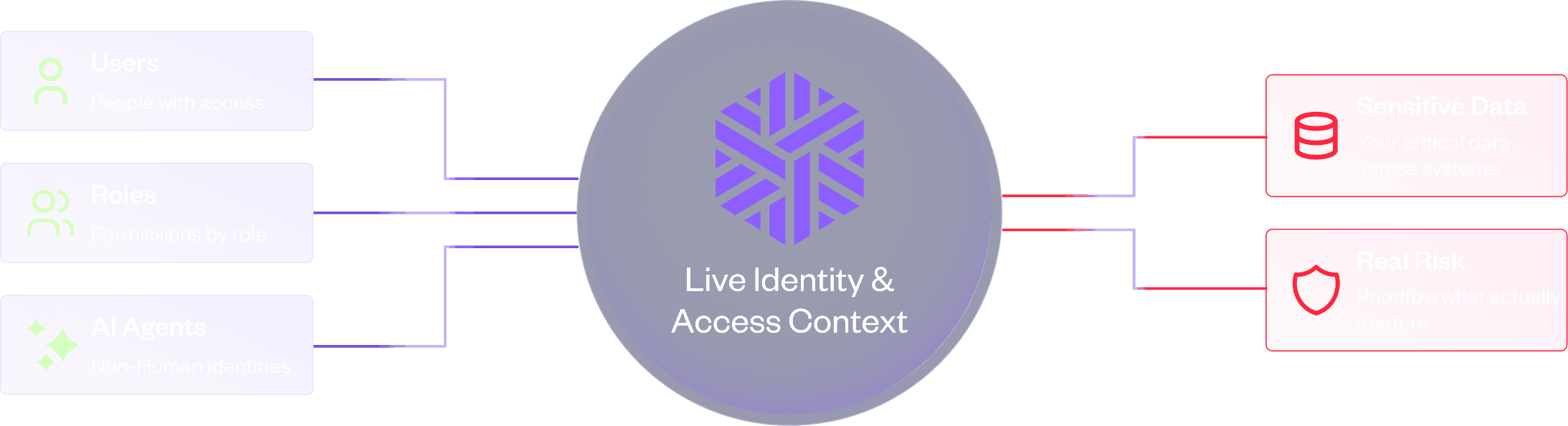
The hardest question in data security is not where your data lives. It is who, and what, can access it. Bedrock Data maps the full access chain for every identity, users, roles, and the AI agents accessing your data at machine speed, then combines it with precise classification to show what is sensitive, who can access it, and the risk it carries.